Tuesday, July 6, 2010

MBA- Class of YEAR 2001

Great fun to great classmates, Great time to Great Faculties...from admission to Impulse.. From site visit to study tours, from summer training to Convocation in last, I enjoyed every moment in IMC, International Management Centre, New Delhi.
Memorable two years!
Sent from BlackBerry® on Airtel

Thursday, July 1, 2010

View

View from JW Marriott Jakarta!

Sent from BlackBerry® on Airtel

FACT

The most used alphabet 'A' doesn't appear in spelling of 1 to 999,it appears for the 1st time in 1000 & continues forever!


Sent from BlackBerry® on Airtel

Sunday, June 27, 2010

Visit to Australia


I was in Australia as a member of business delegation to Perth, Melbourne and Brisbane for a weeks time. From Brisbane i took a charter aircraft to land at small airstrip in mid of the coal belt in Blackwaters. I went to see one of the Coal Mines of our Partners.

Blackwater is known as the Coal Capital of Queensland and the newly built, nine million dollar Blackwater International Coal Centre showcases the Central Highlands Coal Industry for the world. Located on the Capricorn Highway, Blackwater also boasts a fine Japanese Garden, reputed to be the best of its kind in Queensland, that marks the relationship between Blackwater and its sister city Fujisawa, Japan. The coal mines each year around Blackwater produce millions of tonnes of coking and steaming coal. The coking coal is exported to Japan, Italy, the United Kingdom, Holland, France, Spain, Greece, Chile and many other countries, while the steaming coal produced is used for power generation within Queensland.

The Lions Park is well known for one of the largest displays of flags in the world, each flag being representative of one of the 37 nationalities who laboured together in their efforts to establish the district's coal industry.


Just 55 kilometres east from the township of Blackwater you will find the spectacular Blackdown Tableland National Park. Offering you spectacular views and hundreds of plants and wildlife species, some of which are only found in the park. You can enjoy the picnic areas, fireplaces, lookouts, camping area and scenic walking tracks that feature throughout the park.

Friday, June 25, 2010

Football

My Son also have turned Football crazy these days..world cup Fever!

Sent from BlackBerry® on Airtel

Saturday, May 29, 2010

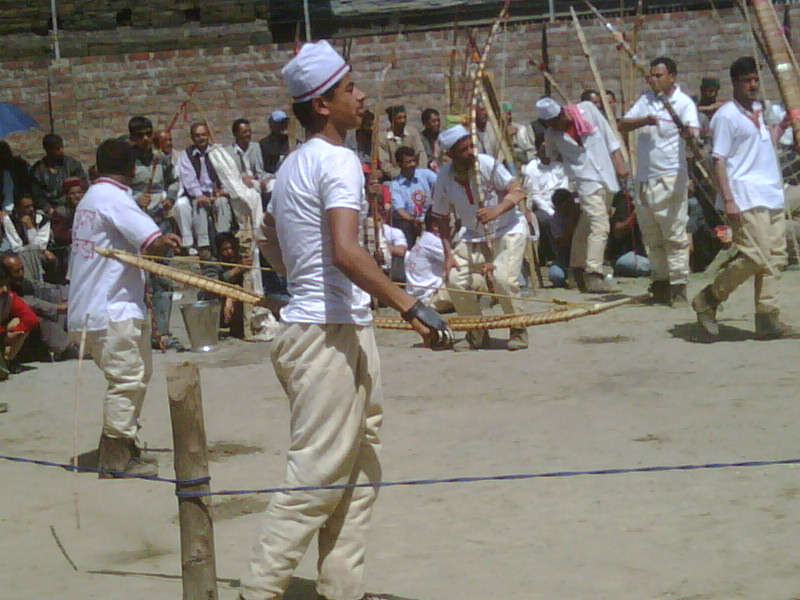
Thoda in BISHU Fair in Shimla


After many Years I got a chance to visit local annual fair of BISHU at my village. This is a traditional folk fair held every year near the temple of the local village GOD. Local martial at Thoda is played for two days in respect of the God. The game of Thoda is organised in a very interesting way. A handful of village folk come to another village, and would challenge them in this fair for fight. Youths would shout, and throw challenges to them for a fight. This would spark the preparations for an encounter and the Thoda being with the bang of Music and Dance.

Thoda is the impressive martial art form of Himachal Pradesh, relies on one's archery prowess, dating back to the days of the Mahabharata, when bows and arrows were used in the epic battles, between the Pandavas and the Kauravas, residing in the picturesque valleys of Kulu and Manali. Thus, this martial art has its origin in Kulu. Thoda, the name is derived, from the round piece of wood fixed to the head of the arrow, which is used to blunt its wounding potential.

The equipment required for this game are bows and arrows. Wooden bows measuring 1.5m to 2m, to suit the height of the archer and wooden arrows in proportion to the length of the bow, are prepared by skilled and traditional artisans. The competition is a mixture of martial arts, culture and sport.

Each group consists of roughly 500 people, but most of them are just dancers, who come along to boost the morale of their team. The archers are divided into parties, just before the competition takes place. One team is called Saathi, and the other Pashi. It is believed that Pashis and Saathis, are descendants of the Pandavas and Kauravas. The target in this game is the region of the leg, below the knee, where the opponent should aim his arrow.

The moment the two contesting groups reach the village fairground, both the parties dance on either side of the ground, waving their swords, aglitter in the sun, and sing and dance to the stirring martial music. The Pashi group forms a 'chakravyuh', and blocks the Saathi group, who in turn begin to penetrate their defences. After the initial resistance, the Saathis reach the centre of the ground. Both the opponents face each other at a distance of about 10 metres, and prepare to attack. The defenders start shaking, kicking their legs to and fro with brisk movements, to thwart the accurate aim of their adversaries.

Lightning movements and agility are the sole methods of defence. The whole competition is conducted to the lively, virile rhythm of war dance, with one side furiously side-stepping, legs kicking in all directions, and other side doing its best to place an arrow on the target. There are minus points for a strike on the wrong parts of the leg.

At present, the game is played in a marked court, which ensures that a certain degree of discipline is maintained in Thoda - a happy blend of culture and sport. This game is popular in Theog Division (Shimla district), Narkanda block, Chopal Division, district Sirmaur and Solan.

In Indonesia........


One week -long visit to Indonesia. We went to scout some coal mines for the Power Plants. I visited Central Kalimantan and is dominated by the Dayaks, the indigenous inhabitants of Borneo. Central Kalimantan is the 3rd largest Indonesian province by area with a size of 153,800 km2, about 1.5 times the size of the island of Java. It is bordered by West and East Kalimantan provinces to the north, by the Java Sea to the south, by South and East Kalimantan provinces to the east, and by West Kalimantan province to west. The Schwaner Mountains stretch from the north-east of the province to the south-west, 80% of which is covered in dense forest, peatland swamps, mangroves, rivers, and traditional agriculture land. Highland areas in the north-east are remote and not easily accessible. Non-volcanic mounts are scattered in this area including Kengkabang, Samiajang, Liang Pahang and Ulu Gedang.

The centre of the province is covered with tropical forest, which produces rattan, resin and valuable timber such as Ulin and Meranti. The southern lowlands are dominated by peatland swamps that intersect with many rivers. Sabangau National Park is a protected peatland area internationally acknowledged as sanctuary for the endangered Orangutan. Recently the peat swamp forests have been damaged by the Mega Rice Project, which unsuccessfully sought to turn large areas into rice paddies.

It wasa great trip from exploring rain forests to taking speed boat on River Barito and to travelling on the log roads with mud in the forest.